Your Delivery Habit Has a Carbon Bill — Here's What You Actually Owe
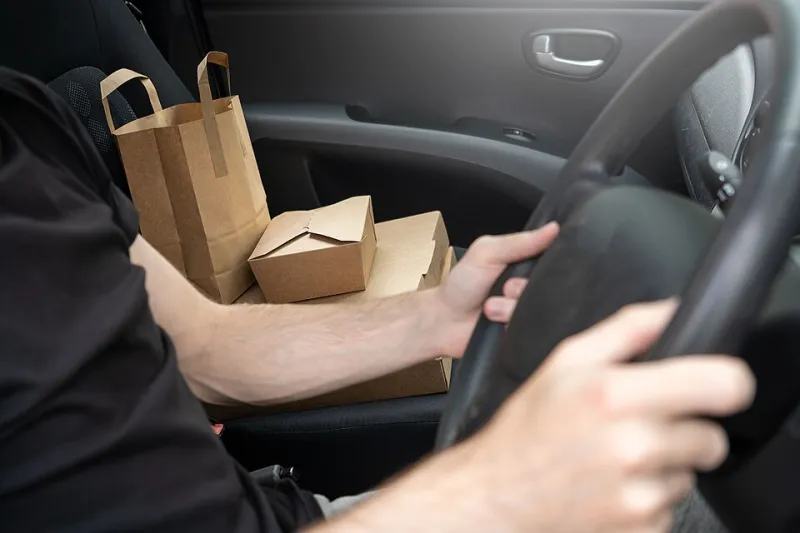
Photo: Meanwell Packaging, CC BY 2.0, via Wikimedia Commons
Let's be real: the delivery economy is one of the most seductive things the modern world has ever built. Dinner from your favorite Thai spot, a replacement phone charger, a six-pack of sparkling water — all of it at your door within an hour, ordered from a couch without pants. The convenience is genuinely extraordinary.
But that convenience isn't free. Not for your budget, and definitely not for the planet. The environmental cost of on-demand delivery is one of the least-discussed dimensions of everyday consumer behavior, and it's one that the companies profiting from it have very little incentive to help you understand.
So let's talk about it.
The Packaging Problem Is Worse Than You Think
Start with what you can see: the packaging. A single food delivery order typically arrives in a plastic bag containing one or more styrofoam or plastic clamshell containers, plastic cutlery wrapped in plastic, paper napkins in a plastic sleeve, and at least one or two sauce containers you didn't ask for and won't use. Almost none of it is recyclable in standard municipal systems.
According to a 2022 report from the Natural Resources Defense Council, food delivery packaging is one of the fastest-growing sources of single-use plastic waste in the United States, with the industry generating an estimated 2.9 billion pounds of packaging waste annually. That number has roughly tripled since 2019, tracking almost perfectly with the explosive growth of platforms like DoorDash, Uber Eats, and Instacart.
Retail delivery isn't cleaner. That Amazon order for a single pair of socks might arrive in an oversized cardboard box filled with plastic air pillows — or worse, in a padded plastic mailer that can't be recycled curbside. The e-commerce packaging waste stream is enormous and growing, with the US generating over 86 million tons of packaging waste per year, a significant and increasing share of which comes from online retail.
Last-Mile Logistics: The Hidden Emissions Culprit
Beyond packaging, the real climate story of delivery is in the transportation — specifically, what the industry calls "last-mile" delivery, the final leg of a package or meal's journey from a local hub to your front door.
Last-mile delivery is disproportionately carbon-intensive for a simple reason: it's wildly inefficient. A delivery driver making 15 stops in a residential neighborhood is burning fuel (or charging a battery) to move one item a short distance, repeatedly. The route optimization algorithms used by major platforms have improved, but they're fighting against the fundamental inefficiency of individualized, on-demand delivery at scale.
A 2020 study from MIT's Center for Transportation and Logistics found that the shift toward e-commerce and on-demand delivery has increased total vehicle miles traveled in many urban areas, even as individual trips became more efficient. Why? Because the sheer volume of deliveries has outpaced efficiency gains. More orders, more trucks, more miles.
Food delivery adds another wrinkle: the cold chain. Grocery delivery services like Instacart and Amazon Fresh rely on refrigerated vehicles and insulated packaging — gel ice packs, foam liners, foil bags — to maintain temperature during transit. Most of that cold-chain packaging is neither recyclable nor reusable, and the refrigerants used in delivery vehicles carry their own significant greenhouse gas implications.
Calculating Your Personal Delivery Footprint
You don't need a PhD in environmental science to get a rough sense of your own delivery impact. Here's a practical framework:
Food delivery: Each restaurant delivery order generates an estimated 0.5 to 1.5 kg of CO₂ equivalent, depending on distance, vehicle type, and packaging. If you're ordering three times a week, that's roughly 75–235 kg of CO₂ annually just from dinner decisions — comparable to driving 200–600 miles.
Retail delivery: The carbon footprint of a single e-commerce delivery varies widely, but estimates from researchers at MIT and Carnegie Mellon suggest an average of 0.4 to 0.8 kg CO₂ per package for standard ground delivery. Two-day and same-day shipping options can be two to three times more carbon-intensive, because they rely on air freight and less-optimized routing.
Tools like the Carbonfund.org calculator and the EPA's carbon footprint estimator can help you plug in your actual consumption patterns and get a more personalized number. It's worth spending 20 minutes doing this — the results are often surprising.
Practical Alternatives That Don't Require Suffering
Here's where we want to be honest with you: we're not going to tell you to delete your apps and start growing your own food. That's not realistic for most people, and sustainability advice that ignores real-world constraints doesn't actually help anyone.
What we are going to suggest is a set of lower-friction swaps that meaningfully reduce your delivery footprint without demanding sainthood.
Batch your orders. Whether it's groceries or retail, consolidating into fewer, larger orders dramatically reduces per-item emissions. Ordering five things from Amazon in five separate transactions is significantly worse than ordering them together — and the same logic applies to grocery delivery.
Default to standard shipping. Two-day and same-day shipping are almost always more carbon-intensive than standard ground. Unless it's genuinely urgent, choosing the slower option is one of the easiest green choices you can make, and it's free.
Try a meal planning week. Just one week of planning meals in advance and doing a single grocery run — or a single grocery delivery — instead of reactive daily ordering can dramatically cut both food waste and packaging waste. Apps like Mealime and Plan to Eat make this more manageable than it sounds.
Explore local food co-ops and CSAs. Community-supported agriculture programs and food co-ops deliver produce and pantry staples with significantly less packaging, shorter supply chains, and often zero last-mile emissions if you're picking up at a local hub. Find options near you at localharvest.org.
Request no utensils. Every major food delivery app now offers the option to opt out of plastic cutlery and napkins. Make that your default setting. It takes ten seconds and it actually matters at scale.
The Bigger Conversation We Need to Have
The delivery economy isn't going away, and honestly, it provides genuine value — especially for people with mobility limitations, demanding schedules, or limited access to transportation. The goal isn't elimination. The goal is consciousness.
Right now, the environmental costs of delivery are almost entirely externalized — meaning you and the planet absorb them while the platforms that profit from your habits don't. Pushing for policy changes that require delivery companies to disclose per-order emissions, invest in EV fleets, and take responsibility for their packaging waste is a legitimate advocacy position worth supporting.
In the meantime, you have more power than the apps want you to realize. Every batched order, every standard shipping selection, every opted-out plastic fork is a small but real act of resistance against a system designed to make convenience cost nothing.
It costs something. Now you know how much.