You Already Own Four Reusable Cups. That's the Problem.
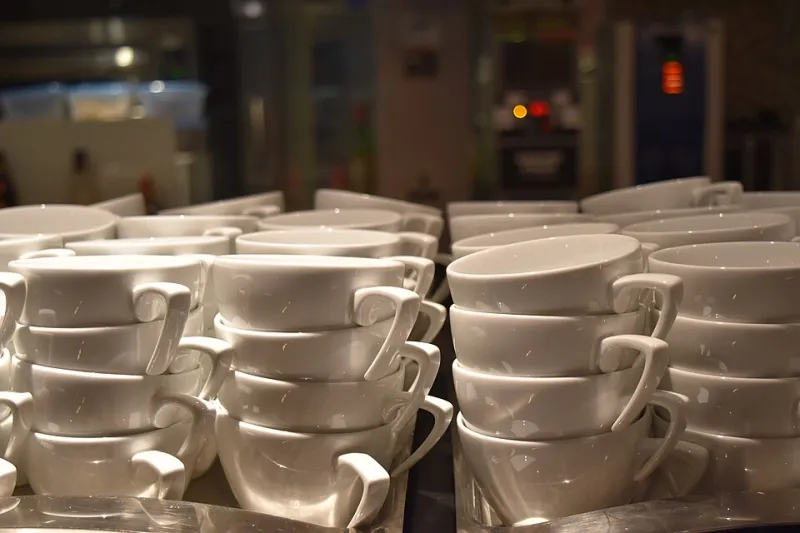
Photo: Andrew Currie, CC BY-SA 3.0, via Wikimedia Commons
I want to talk about the cup in your car.
Not the one you use. The one that lives in the cup holder, or the door pocket, or that weird well behind the gear shift. It's a nice one. Maybe it was a gift. Maybe you bought it during a phase. It has a silicone sleeve and a bamboo lid and it has never once carried coffee into a building, because it lives in your car and you live in your house and those are two different places.
Meanwhile there are three more in your kitchen cabinet. And a collapsible one in your bag that you forget is there. And a steel bottle you bought because the last steel bottle got dented.
Here's my blunt read: for most of us, the eco-product aisle is not a solution to overconsumption. It's a second aisle of overconsumption with better branding.
The drawer full of good intentions
Every reusable thing in your house is a monument to a moment when you fully intended to change your behavior. The intention was real. The purchase was a way of feeling like the change had already happened. And then the actual moment arrived — you're in line at a coffee shop, hand on your wallet, barista asking for your order — and the cup is forty minutes away in a car that's parked two blocks in the wrong direction.
That gap, between the person who buys the cup and the person who orders the latte, is the entire ballgame. Climate communication researchers have a name for it, the intention-behavior gap, and it's the most reliable finding in the field: people consistently report caring about sustainability at rates far higher than their behavior reflects.
We keep trying to close that gap with stuff. It doesn't close with stuff.
Why the intention dies at the register
Buying feels like doing. That's the whole trick. A purchase produces a little dopamine hit, a sense of progress, and a clean narrative — I'm the kind of person who brings their own cup. Remembering to actually bring it produces no dopamine at all. It produces the mild annoyance of carrying a damp cylinder around all day.
So we buy, and the buying substitutes for the remembering. Psychologists call this moral licensing, and it's why you can walk out of a store with a tote bag and feel more sustainable than you did walking in, even though nothing material has changed except your bag inventory.
The uncomfortable conclusion: the reusable cup market is growing for the same reason the disposable cup market is growing. Because buying is easy and changing is not.
Stop optimizing the object, start designing the situation
If the problem is that the cup isn't where you are when you need it, the answer is not a better cup. The answer is a better default.
Stage, don't store. The cup that works is the one that lives where the behavior happens. If your coffee stop is on the drive to work, the cup lives in the car. If it's the office kitchen, the cup lives on your desk. Storing a reusable item neatly in a cabinet is the same as not owning it.
Buy multiples, but only for the friction point. This is the one place I'll defend owning three of something. A cup at home, a cup at work, a cup in the car is a system designed around how humans actually operate. Three cups in the same cabinet is a collection.
One in, one out. Before any reusable item comes into the house, one leaves. Not into a closet. Out the door — donated, gifted, used. If you can't name which one is leaving, you're not replacing anything. You're accumulating.
Make it visible. Reusables die in drawers. The ones that survive are the ones you trip over. Put the bag by the door. Hang the cup from the keys. Ugly beats forgotten.
Attach it to an existing habit. You already have a routine for leaving the house. Pick one anchor — grabbing keys, letting the dog out, putting on shoes — and hang the reusable item on it. New habits survive when they're parasites on old ones.
The blunt test
Before you buy another reusable anything, ask three questions.
- Do I already own a functioning version of this? If yes, you don't need it. You need a staging plan.
- What specific moment will I use it in, and where will it be at that moment? If you can't answer with a location, don't buy it.
- Am I buying this because it solves a problem, or because it makes me feel like the problem is solved? Be honest. Nobody's watching.
The third question is the one that hurts, and it's the one that matters. Most of us are not short on gear. We're short on friction-removal.
What I actually do now
I stopped buying reusable bags. I have eleven; nothing new gets added. I keep one crate in the trunk with the bags already unfolded, because the failure mode was never forgetting them — it was not wanting to fold them at the register.
I keep exactly one cup in the car and one at my desk and I did not buy either of them; both came from the cabinet graveyard. And when I catch myself browsing a new insulated tumbler, which I do roughly once a month, I go look at the four in my kitchen and feel appropriately embarrassed.
The reusable cup in your passenger seat is not evidence that you're bad at sustainability. It's evidence that you bought a solution instead of building one. The good news is the building is free, and you probably already own the parts.