Green on the Outside, Dirty on the Inside: How to Spot a Greenwashing Scam Before It Gets Your Money
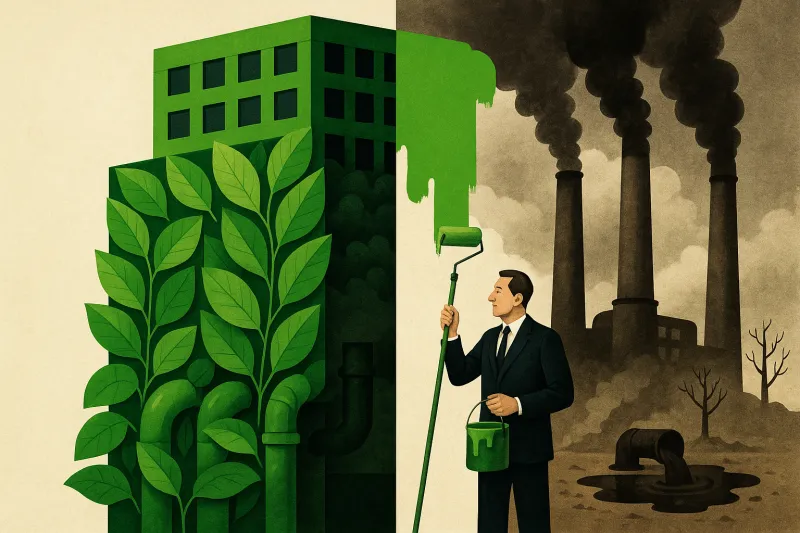
Photo: greenwashing eco label product marketing deceptive packaging, via shopequo.com
Let's be honest: shopping sustainably in America right now feels like navigating a maze designed by people who really, really don't want you to reach the exit. Every other product on the shelf is wrapped in kraft paper and earth tones, slapped with words like "natural," "clean," "responsible," or "eco-conscious" — and almost none of it means what you think it means.
This is greenwashing: the practice of making a product (or a company) appear more environmentally friendly than it actually is, specifically to capture the growing market of consumers who give a damn. It's not new, but it has gotten dramatically more sophisticated. And as conscious shoppers, we need to get smarter faster.
Here are seven of the most common misleading labels and tactics you're likely to encounter — and what to look for instead.
1. "Natural" — The Label That Means Absolutely Nothing
We'll start with the big one. "Natural" has no regulated definition in the United States when it comes to most consumer products. The FDA has a loose, informal policy on the term for food, but for cleaning products, personal care items, and household goods? Zero legal standard. Zero enforcement. Zilch.
A product can be labeled "natural" while containing synthetic preservatives, petroleum-derived ingredients, and chemicals that are decidedly not what you'd find in a forest. Companies know this, and they use the word freely because it costs them nothing and sells products.
What to look for instead: Certified organic (USDA Organic for food and some personal care), or third-party verified ingredient transparency from organizations like the Environmental Working Group (EWG). The EWG's Skin Deep database rates personal care products based on actual ingredient safety — bookmark it.
2. "Recyclable Packaging" When It's Actually Not Recyclable Where You Live
This one is sneaky. A product can technically be made of recyclable materials — certain plastics, mixed paper, composite materials — while being functionally unrecyclable in the majority of American municipalities. Recycling infrastructure varies wildly across the country, and what gets processed in San Francisco might go straight to landfill in rural Tennessee.
Brands know this. When they print "recyclable" on packaging without specifying the conditions under which that's true, they're banking on you assuming your curbside bin will take care of it.
What to look for instead: Packaging that's certified by How2Recycle, which provides specific, verified guidance on what parts of packaging are recyclable and under what conditions. It's not perfect, but it's a real standard with actual accountability behind it.
3. The Vague Carbon Claim — "Carbon Neutral," "Net Zero," and Other Fuzzy Math
Carbon neutrality claims have exploded in recent years, and so has the controversy around them. Many brands achieve "carbon neutral" status by purchasing carbon offsets — essentially paying another entity to theoretically absorb or avoid the emissions the brand is producing. The problem is that the carbon offset market is notoriously difficult to verify, and investigations by outlets like The Guardian and Zeit Online have found that a significant portion of certified offsets don't deliver the climate benefits they promise.
"Net zero" is similarly murky. Without a clear methodology, a verifiable third-party audit, and a credible timeline, these claims can be more about optics than actual emissions reduction.
What to look for instead: Look for brands that publish detailed, third-party verified sustainability reports — not just press releases. The Science Based Targets initiative (SBTi) sets a more rigorous standard for corporate climate commitments. If a brand has an SBTi-verified target, that's more meaningful than a self-declared "carbon neutral" badge.
4. Single-Attribute Marketing — "Made With Recycled Materials"
Here's a classic misdirection move: highlight one green attribute loudly while the rest of the product's lifecycle is an environmental disaster. A water bottle "made with 20% recycled plastic" sounds good — but what about the other 80%? What about the supply chain? The shipping? The end-of-life disposal?
This is called single-attribute greenwashing, and it's everywhere. A fashion brand might trumpet its "sustainably sourced cotton" line while the rest of its catalog is straight-up fast fashion. An airline will sell you carbon offsets for your flight while lobbying against aviation emissions regulations.
What to look for instead: Look for holistic transparency. Does the brand publish a full lifecycle assessment or a comprehensive sustainability report covering supply chain, manufacturing, packaging, and end-of-life? B Corp certification is one of the more rigorous whole-company standards available.
5. Fake or Unverifiable Certification Logos
Some brands create their own in-house "certifications" — complete with official-looking logos and seals — that have no third-party verification behind them whatsoever. "Certified Green by [Brand Name]'s Own Internal Committee" is meaningless, but it looks credible enough at a glance to influence purchasing decisions.
Even real-looking certification logos can be manipulated. Some brands use outdated certifications they no longer qualify for, or display logos from organizations with minimal verification standards.
What to look for instead: Know your legitimate third-party certifications. For cleaning and household products: EPA Safer Choice. For personal care: COSMOS Organic, EWG Verified. For food: USDA Organic, Non-GMO Project Verified. For textiles: GOTS, Fair Trade USA, OEKO-TEX. When in doubt, Google the certification name — legitimate ones will have a clear, searchable database where you can verify a brand's membership.
6. "Clean" Beauty and Personal Care — A Completely Unregulated Marketing Term
"Clean beauty" has become a multi-billion-dollar marketing category built entirely on a word that has no legal definition, no regulatory standard, and no enforcement mechanism in the US. Brands define "clean" however is most convenient for them, which often means avoiding a handful of high-profile "bad" ingredients while keeping dozens of others that are equally questionable.
The FDA regulates cosmetics far less stringently than most Americans assume. The EU has banned or restricted over 1,300 ingredients in personal care products; the US has banned or restricted fewer than 15. "Clean" in this context is doing a lot of heavy lifting for a word that doesn't technically mean anything.
What to look for instead: EWG Verified is one of the stronger standards in this space. MADE SAFE certification is also worth knowing — it requires that every ingredient be evaluated against a comprehensive list of known harmful substances.
7. Sustainability Commitments With No Timeline or Accountability
Perhaps the most sophisticated form of greenwashing is the ambitious-sounding future commitment that conveniently never has to be delivered on right now. "We're committed to achieving 100% sustainable packaging by 2040" sounds impressive. But 2040 is a long time away, and without interim milestones, third-party verification, and binding accountability, it's essentially a press release dressed up as a promise.
This tactic lets brands capture the goodwill of environmental messaging today while actually doing very little to change their operations in the near term.
What to look for instead: Look for brands with near-term milestones, published annual progress reports, and external verification. If a company's sustainability page is full of beautiful photography and aspirational language but lacks specific data and verified progress updates, that's a red flag.
The Bottom Line: Trust, But Verify
Here's the uncomfortable truth: in an environment where greenwashing is this pervasive, a healthy dose of skepticism is a survival skill for conscious consumers. That doesn't mean you need to be paralyzed by cynicism — genuinely sustainable brands do exist, and they deserve your support.
But it does mean doing a little homework. Check certifications. Read the actual sustainability reports, not just the landing page copy. Follow investigative journalists and organizations like the Environmental Defense Fund, Green America, and the Story of Stuff Project, who track corporate environmental claims.
Your purchasing power is real. The market responds to where money flows. When you direct yours toward brands that have actually earned the green label — rather than just printed it — you're helping shift the incentive structure for the entire industry.
And when you call out greenwashing — to friends, on social media, in product reviews — you're doing the rest of us a favor too. Sunlight is still the best disinfectant.