The 47,000 Photos You'll Never Look At Again Are Still Burning Coal
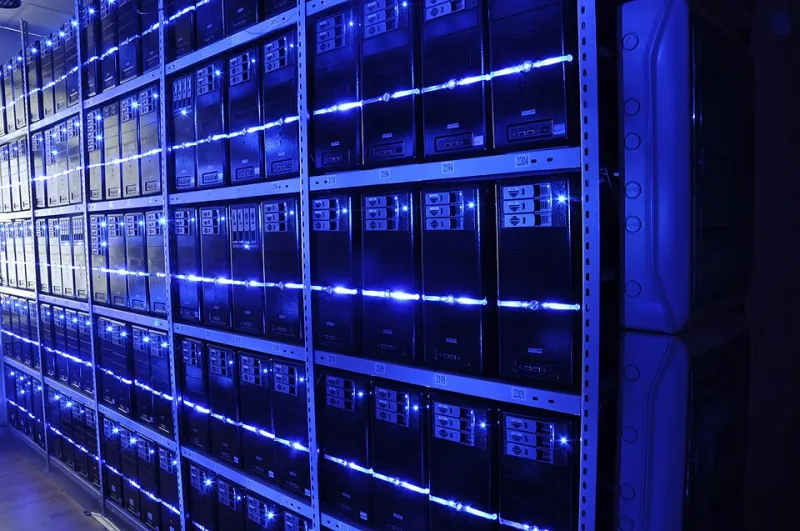
Photo: BalticServers.com, CC BY-SA 3.0, via Wikimedia Commons
There is a windowless building in Ashburn, Virginia, with a lot of fans and a very large electricity bill, and part of it exists because you have never deleted a screenshot.
That is not a moral accusation. It is plumbing. The cloud is not vapor; it is real estate, copper, water, and turbines somewhere west of you. And the stuff you never look at costs roughly the same to keep as the stuff you do.
The cloud is a place, and the place has a meter
Data centers in the US consumed somewhere around 4.4% of the country's electricity in 2023, according to Lawrence Berkeley National Laboratory. Their projection for 2028 lands between 6.7% and 12%, with most of that growth driven by AI hardware. Analysts keep revising those numbers upward, which tells you something about how confident anyone should be in the low end.
So when a provider hands you 2 terabytes for the price of a sandwich, they are not being generous. They are betting you will never use it, and they are buying power on a contract that is cheaper than yours. You are the product's storage problem, and the grid is the co-signer.
What one gigabyte-year actually costs
This is where the honest answer has to be a range, because storage energy depends on how many copies a provider keeps, how often your files get touched, and whether they live on a spinning disk in a cold tier or a rack that is warm and waiting.
Published estimates for a stored gigabyte-year run from roughly 0.5 kWh to 7 kWh. That is a wide spread, and anyone quoting a single number to three decimal places is selling something.
Run it on a realistic library — say 100 GB of photos and video, which is a modest camera roll these days:
- 100 GB × 1 kWh = 100 kWh a year, about 36 kg of CO2e on the US grid
- 100 GB × 7 kWh = 700 kWh a year, about 250 kg of CO2e
That second number is roughly 600 miles in a comparable gasoline car. The first is a long weekend's worth of driving.
Now the proportion check, because this is where most green-tech writing loses the plot. The average American's annual footprint is around 16 metric tons. A 100 GB library is somewhere between 0.2% and 1.5% of that. A single round-trip flight from New York to Los Angeles is about 0.9 tons — call it four to twenty-five times your entire photo archive.
So no, your camera roll is not the climate villain. But 0.2% multiplied by a couple hundred million people with the same camera roll is a power plant.
The parts of this that are bigger than your photos
Two things in your digital life actually move the needle, and neither is a JPEG.
Streaming is mostly a screen-size story. An hour of HD streaming pulls maybe 0.06 to 0.2 kWh across the network and data center. Your 65-inch TV pulls 0.1 to 0.2 kWh on its own in the same hour. The screen usually outweighs the pipes. Watching on a laptop instead of the big set saves more than any resolution setting will.
AI prompts are small individually and enormous in aggregate. A text query runs in the thousandths of a kilowatt-hour; image generation costs more per request. Multiply by billions of daily requests and you get the reason utilities in Georgia and Northern Virginia are filing for large-load tariffs right now. The growth curve is not being driven by your photo library. It is being driven by capital expenditure.
The audit that takes twenty minutes
No hair shirt required. Do these in order and stop when you get bored, because the last five items are worth almost nothing.
- Turn off automatic video backup. A single 4K clip of a birthday party can be 2 GB. Video is 90% of the bloat and 2% of the sentimental value.
- Kill the near-duplicates. Every modern phone shoots twelve frames of every photo. Most gallery apps now surface bursts and screenshots for bulk deletion. Ten minutes, tens of gigabytes.
- Check your storage tier. Providers quietly upsell you from 200 GB to 2 TB the moment you cross a line. Downgrade and see if anything actually breaks.
- Move the cold archive to a drive you own. A single external drive has a manufacturing footprint in the tens of kilograms of CO2e — real, but one-time. For files you touch twice a decade, that beats a decade of triple-redundant replication.
- Set your phone to optimize storage. Both major platforms will swap full-resolution originals for thumbnails and pull the real file back on demand. Free, invisible, effective.
- Turn off autoplay. It exists to keep you watching. It works.
What not to do
Do not delete your friend's wedding video so you can post about your digital declutter. Do not buy a two-hundred-dollar drive you will never plug in, because the guilt purchase is now e-waste with a receipt. And do not spend a Saturday evening purging blurry dog pictures while the actual infrastructure decision gets made without you.
Where you have real leverage
Storage companies love to promise 100% renewable energy and then buy unbundled renewable energy certificates that represent last year's megawatt-hours in a different region. Annual matching is better than nothing and worse than what it sounds like. Ask whether the provider does hourly-matched clean energy in the same grid region. Most will not answer clearly, which is your answer.
Meanwhile, the load growth is landing on your utility bill. State public utility commissions — Virginia's SCC, Georgia's PSC, and their peers — are where large-load tariffs and data center cost allocation get decided, and those hearings are public. Showing up matters more than deleting 400 screenshots.
The bottom line
Clean up the obvious waste, because it is free and it takes an evening. Then stop there. The kilowatt-hours in your camera roll are a rounding error next to a flight, a car commute, or a beef habit — and the growth in data center demand is not something you caused by taking too many pictures of your dog. It is something you can comment on, at a hearing, in writing, on the record.